Board

Future capacity is built with a senior board.

Interpreting change, deciding under ambiguity and holding the course don't fit in a single head. Change brings together the ways of thinking a hard decision needs at the same time.

Why a board

The course shouldn't depend on a single head.

Uncertainty isn't resolved with more opinion, but with ways of thinking that correct each other. Each profile covers a part of a decision's arc: read the signal, interpret what it means, decide what matters, design the response and sustain the learning.

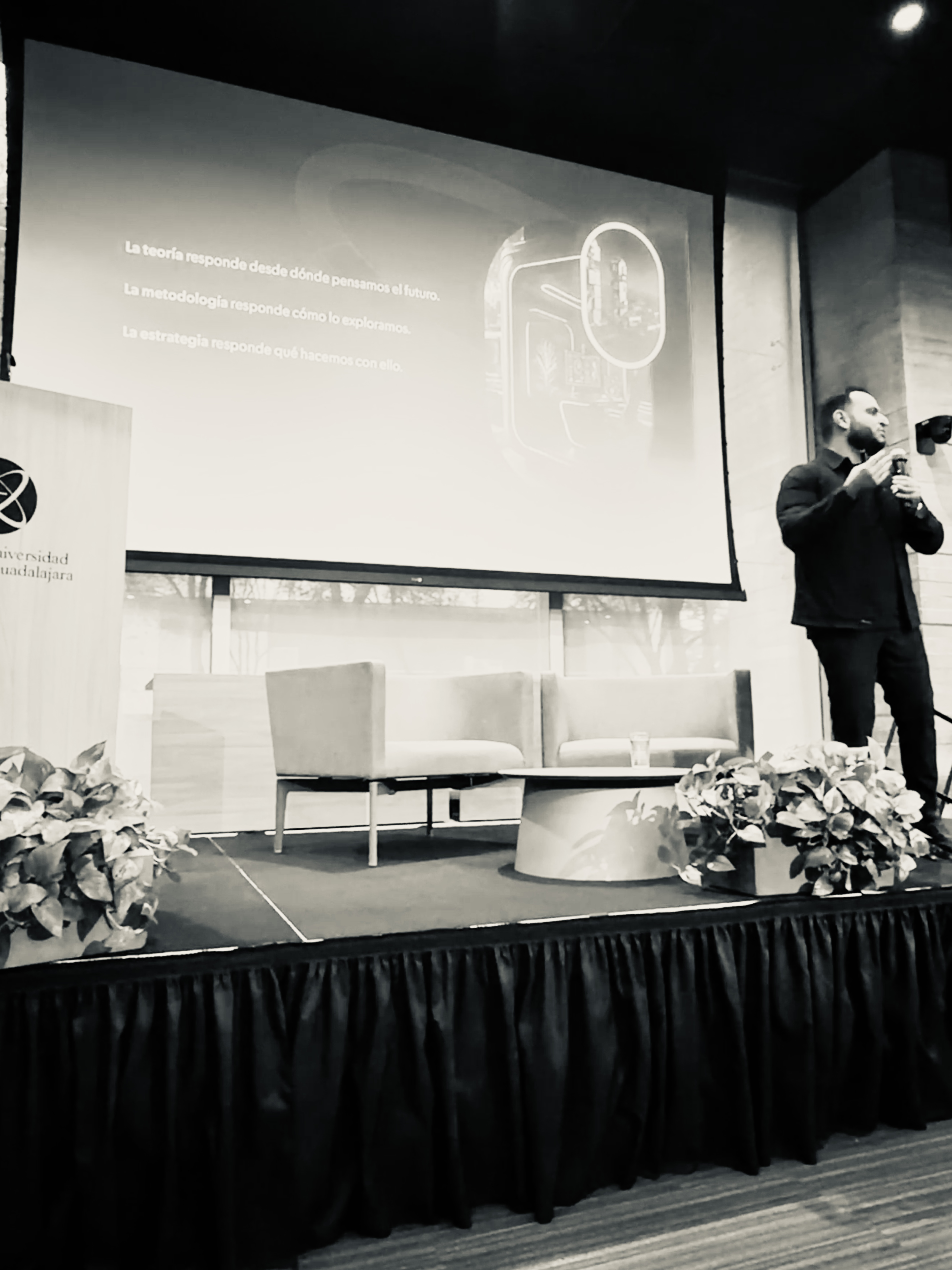
Andrés Valencia presenting at Universidad de Guadalajara
Founding partners

Change was born from two complementary obsessions: reading change in time and turning it into a decision that holds.

Two founders, two disciplines, one method. We don't split a project into tasks: we split a decision into capacities. And the method isn't delegated — it's governed from here.

Andrés Valencia

Foresight and strategic innovation

Sees the signal while it's still weak.

He chaired Mexico's Innovation and Design Promotion Council and served on the board of The Design Futures Initiative. From there he understood something uncomfortable: organizations rarely fail for lack of information — they fail by not reading it in time. He founded Change to close that gap: read the future while it's still a signal, and name the tension no one in the room dares to say out loud.

Miguel Cadena

Strategy, intellectual property and business models

Turns the intangible into profitability.

He advised multinational companies on intellectual property and business models, and teaches it at undergraduate and graduate level. His conviction is simple: a decision is only worth it when its costs are on the table and someone can defend it before the board. At Change he turns the diagnosis into bets with explicit criteria — the ones that hold on their own when pressure arrives.

Andrés + Miguel

Reading and landing, seamless

Two disciplines, one method.

Andrés reads the future while it's still a signal; Miguel turns it into a decision with explicit costs. They founded Change so neither half works alone: diagnosis without landing stays intuition, and execution without diagnosis stays inertia.

How we come in

The work starts with a decision, not a retainer.

Entry

Clarity Map

A first diagnosis of the decision and its tensions. The point where you see whether it's worth going deeper.

Bounded

Direction Sprint

A stretch of work with defined scope to take a decision from diagnosis to design, with artifacts at the end.

Living system

Mission Control

The infrastructure that sustains learning over time. It arrives when there's already a working relationship, never cold.

Bring the decision weighing on you most today.

You don't need the problem or the path figured out. That's exactly what the board does with you.

Trabajar una decisión